 +971 50 5473745


SEO vs. PPC: Which Digital Marketing Strategy is Right for Your Business?

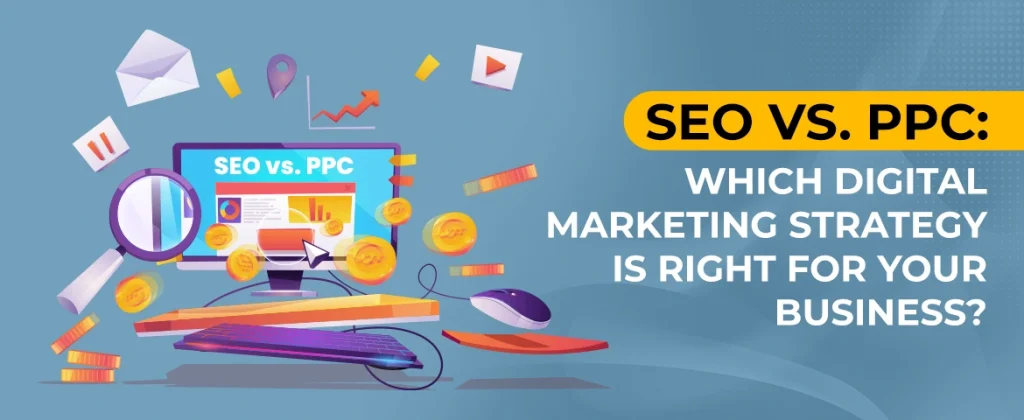
In the virtual world, businesses have a number of marketing strategies that can reach out to their desired customers. Out of all those strategies, SEO and PPC advertising are the two crucial strategies that companies use. Both of these have strengths as well as weaknesses. Therefore, companies have to choose from these two what suits them the best. In this blog post, we’re going to go through the pros and cons and ideal use cases for both SEO and PPC to help you decide which is right for your business.
Understanding SEO and PPC
What is SEO?
SEO is the process of making sure that your site and its content, in all its iterations, are search engine friendly. Essentially, what that means is that the ultimate goal of SEO is to have a higher ranking in the search results if the content being searched for is entered or inserted as keywords for Google. The more traffic you bring to your site, the better, but pay-per-click isn’t necessary.
What is PPC?
PPC, on the other hand, pays for ads shown on SERPs or other sites. The model comprises competitive bidding by advertisers on keywords whereby an advertiser pays for each click by a visitor to their site. This means that each time an ad is clicked, there usually is instant exposure and traffic is generated.
The Benefits of SEO:
- Cost-Effectiveness: While SEO does have an upfront investment in time and resources, it will eventually bring in positive, long-term results without cost-per-click ongoing fees. Once your site is established well in rankings, you can typically maintain that placement with little or no additional expense.
- Credibility and Trust: The user trusts more on organic search results than paid ads. A high ranking can give your brand much credibility and authority in your niche.
- Sustainable Traffic: A well-optimized website will continue to attract traffic over time, that will consequently generate leads and convert over the long haul as a result of that initial effort.
- Expanded Reach: SEO can help you reach a wider audience through multiple keywords and phrases, thus increasing your visibility in search results.
- Improved user experience: SEO generally enhances the user-friendliness and structure of a website; therefore, enhancing its user experience. Fast page loading and mobile optimization keep the users engaged.
- Increased Brand Visibility: Even though the users may not click on the link immediately, increased organic rankings help to brand awareness and visibility.
- Organic Click Through Rates: Studies have shown that organic search results have click-through rates dramatically more than paid ads thereby producing more opportunities for engagement.
- Long-term asset: In the context of well-optimized websites, any website can be termed as a long-term asset, which will continue to fetch interest in terms of traffic and potential conversion over time.
Disadvantages of SEO
- Time-Consuming: SEO is not a magic overnight solution. You will first see the fruitful results after considerable months of SEO as time needs to be taken by search engines for crawls and indexing your site.
- Algorithms Keep Changing: Search engines are updating their algorithm regularly. So usually, that affects your ranking. You have to keep up with those changes very repeatedly.
- High Competition: Sometimes it becomes unachievable to rank for competitive keywords, depending on your industry, and especially when compared to an established player.
- Requires Expertise: There is always a need to acquire higher knowledge in such areas as content creation, keyword research and technical optimization for effective SEO, which can call for hiring or training an expert.
- Possibility of Punishments: Black-hat SEO techniques primarily designed for ranking manipulation can lead to search engine penalties that could severely devastate the visibility of your website.
Benefits of PPC
- Instant traffic: The advantage of PPC is that you can get traffic in almost no time at all. After your campaign goes live, your ads may show up in search results soon.
- Targeted Advertising: PPC allows targeted advertising to different locations, demographics, and even keywords to ensure your ads are seen by the right people.
- Measurable ROI: PPC will make it very simple to track metrics such as click-through rates, conversion rates, and overall ROI; enabling you to alter campaigns to perform better.
- Flexibility: You can very easily change your PPC campaigns, right from the keywords to altering your budget to changing different ad copy to optimize performance.
- Budget Control: PPC delivers an accurate control over budget with the capacity to set daily limits and the potency to intervene with your spending based on performance.
- A/B Testing Opportunities:The biggest perk of PPC is that it offers extensive A/B testing options wherein you can try out different formats for ads, headlines, and calls to action for their optimal performance.
- Ad extensions : This is where a PPC platform provides you with some features such as site links and call buttons that can be added to an ad to enhance it further and provide additional information to a prospect.
- Remarketing opportunity: PPC allows you to retarget users who have previously engaged with your site. This increases the likelihood of converting the opportunity when you bring such users back to your offerings.
Weakness of PPC
- Cost: PPC can be rather expensive depending on what niche and competition. Costs can quickly add up, especially when your ads aren't converting well.
- Temporary Traffic: As soon as you stop funding PPC campaigns, traffic goes away. With SEO, you can always expect long-term benefits, but with PPC, you need to keep throwing more money at it if you want to remain top of mind.
- Ad Blindness: Most users opt to ignore paid adverts and focus instead on organic search results. That reduces the value you would have gained through PPC efforts.
- Click Fraud: There is a phenomenon known as click fraud, which arises when competitors or bots may click your ads without any intention to engage with the content and thus increase your advertising costs without generating real leads.
- Ad Fatigue: Audiences tend to get numb to the same ads over and over and over, leading to decreased engagement and higher costs per click.
- Limited Real Estate: In competitive industries, there is simply not much to go around on SERPs, making it difficult to get real visibility without a relatively large budget.
When to use SEO:
- Long-term strategy: If you are looking for sustainable, long-term traffic and don't mind investing your time, then SEO is good.
- Brand Authority: If brand credibility and trust are what your main objective is, then organic search rankings can help create a brand as an industry leader.
- Low Budget: Assuming you have a low budget for advertising but can spend much of your time in developing quality content and then optimizing them, SEO can be more feasible.
- Niche markets: In case a niche market that you are operating in has fewer competitors, then focusing on SEO would be a good strategy for building your online presence.
- Content-Driven Strategy: Companies that are doing content marketing in the form of blogs, articles, and guides will see a huge impact from SEO because it aligns perfectly with attracting organic traffic through valuable content.
When to Use PPC?
- Quick Traffic: For instance, if the product is newly launched or you want to run a promotion, PPC will give you results quick and fast
- Specific Campaigns: Short-term campaigns, events, or sales require the right messaging to audiences; PPC can target them specifically
- Testing and Insights: Should you be testing different keywords or messages at scale quickly, PPC gives valuable insights, and that can serve as your guiding light in the general marketing strategy.
- Seasonal Promotions: Companies selling seasonal items can utilize PPC to offer highly targeted campaigns that could be switched on/off when a certain time of the year comes along.
- Lead Generation Campaigns: If it's quickly generating leads, then PPC can attract their attention and drive them to landing pages optimized for conversion.
Conclusion
The choice between SEO and PPC is a very important decision that determines your whole digital marketing strategy and the potential growth of your business. As with any tool, each one has its pros and cons, solves different problems, and therefore complements each other perfectly in the marketer’s toolkit.
SEO: A Long-Term Investment
The search engine optimization is best viewed as a long-term investment. Though it has a longer gestation period for results, it yields sizable and long-lasting rewards. Since you are focusing on search engine optimization for your website, you do have sustainable organic streams of traffic. It’s not only the credibility of your brand but also the positions of authority in your industry that this affords you. Thirdly, with the investment of SEO, you are able to improve the user experience while also probably escalating the engagement rates and ultimately, conversion rates.
But then again, what really needs to be recalled is that SEO work has to be done continuously and requires expertise. Thus, it means staying updated with the changes in the algorithms and following the best practices of the industry via which rankings are maintained and improved. Though an investment of time and resources into SEO is required, for businesses capable of dedicating the time and resources to do so over a period of time, SEO is a valuable strategy in developing online presence.
PPC: Quick Results with Flexibility
On the other hand, businesses who need the results to come in now typically look for PPC as an alternative. For PPC, with generation of instant traffic and leads, it is particularly effective for time-sensitive campaigns, such as a product launch or seasonal promotion. Its flexibility in adjusting budget, demographics targeting, and ad format makes PPC an effective tool for the marketer, looking to optimize his campaign quickly.
At the same time, one needs to take into account PPC costs that may well be especially high in competitive niches, where keyword bids may very quickly spiral out of hand. Businesses need to be prepared to test and to continue optimization of their campaigns so as to optimize ROI as well. Companies seeking quick awareness, and not being afraid to throw good money at a good planned program, can garner huge short-term paybacks through PPC.
A Combined Approach: The Best of Both Worlds
Many of the companies that have had the most success use a hybrid approach, leveraging both SEO and PPC to maximize their outcomes. Using both will enable marketers to benefit from the near-instant lift in traffic that PPC offers, while developing the long-term value from SEO. For instance, PPC may be deployed to start the flow of traffic to a new website or product, and those SEO efforts will be started simultaneously to build organic visibility over time.
PPC efforts yield insights that feed into the SEO strategy. It helps make recommendations on types of keywords and audience preferences, which have gone exceptionally well. The harmony created in that regard makes for a more holistic marketing approach-one that yields higher levels of visibility, engagement, and conversion.
Final Thoughts
In fact, the SEO or PPC choice must be aligned with your business goal, target, and resource. Taking factors related to your industry, the intensity of competition in that sector, and so forth, and possibly even your marketing budget, into consideration is of paramount importance. Once you understand how each strategy complements the other, you will be able to make well-informed decisions, specific to achieving business goals.
Digital marketing cannot be static: it is in constant evolution. Therefore, your strategy should be, as well. Checking your performance regularly, following trends in your industry, and adapting to change keeps your efforts effective and updated within a fluid digital world. Whichever path you take, commit with a plan and willingness to pave your way towards success.
Let's elevate your brand with the #1 digital marketing agency in Abu Dhabi!
Don’t let your competitors outshine you! Let HelloPixels bring you the transformative magic of its digital marketing services. Having at heart a strong emphasis on measurable results and over-and-above expectations for clients, we take the responsibility to expand your business to new heights. Call now to find out how we can build a customized strategy that sends your brand shooting forward in this virtual landscape!

Facts behind Companies in Dubai focusing on Digital Marketing
Digital marketing is a modern and cost-effective marketing tool. The endless benefits and resources

How to use Google trends for YouTube
Need guidance on your keyword and content strategies for YouTube? Learn five ways you can use Google
15 Digital Marketing Strategies Every Business Should Implement in 2025
As we step into 2025, the speed at which the landscape of digital marketing is changing is only a pa


