 +971 50 5473745


Neuro-Marketing in the Digital Age: Can AI Read Minds Better Than Marketers?

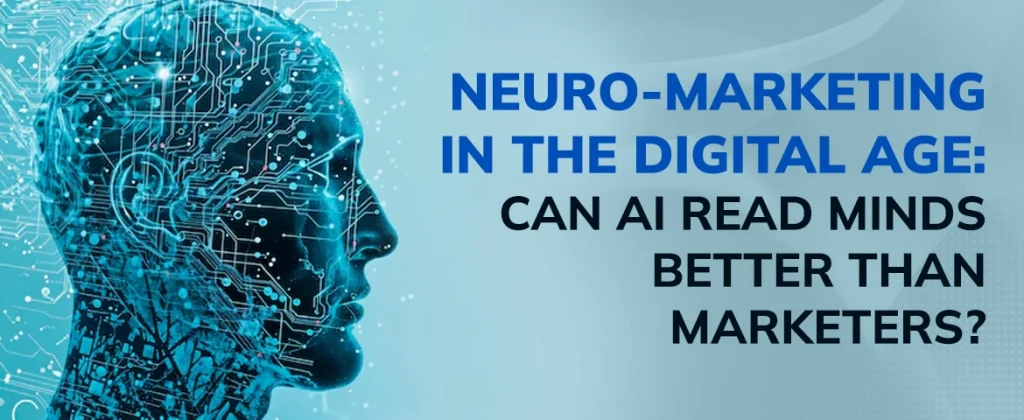
In the fast-changing space of digital marketing, recognizing consumer trends and habits is not only a competitive advantage but a strategic imperative. Data is becoming richer and AI is becoming smarter, and a fascinating area along the intersection of neuroscience, psychology, and technology is called neuro-marketing. This very interesting field aims to use hard science to examine the subconscious level of understanding that drives buying decisions; AI is emerging as the most powerful tool for neuro-marketing.
What is Neuro-Marketing?
- Eye movement
- Facial expression
- Heart rate and skin conductance
- Brain wave activity (EEG)
The AI Edge: Converting Signals to Strategy
1. Facial Expression Analysis
Use case:
2. EEG and Brainwave Pattern Recognition
Use case:
3. Voice Emotion Recognition
Use case:
4. Predictive Models with Biometric Data
Use case:
- Movie studios can run the trailers through neuro-marketing tests to determine the success at the box office.
Why Traditional Marketers Are Being Disrupted
- Bias in Feedback: People rarely say what they really feel, especially when it comes to focus groups or surveys.
- Sample Size Limitation: Human research is slow and continues to struggle with the number of people sampled to be genuinely reflective of the market.
- Surface-Level Metrics: Click-through rates and bounce rates still don't tell us why someone clicked or bounced.
Can AI Replace Human Marketers?
Here’s how the roles are evolving:
Human Marketer
AI System
The Ethical Edge: Is Mind-Reading Taking It Too Far?
- Consent: Are individuals fully informed that they will be tracked by facial expression, or brain waves?!
- Manipulation: If AI knows precisely what emotional button to push is it free choice?
- Data Privacy: Biometric data is uniquely biometric. Who owns it? How is it stored? Secured?
A Look into the Future:
- Smart Glasses that are able to track gaze in real worlds
- Fitness bands that can measure emotional response while presenting in-store experiences,
- Voice assistants that will be able to alter tone and cadence when responding to a consumer based on detectable increases in stress.
- AR/VR experiences to measure the level of attention and presence and alter them accordingly in real-time.
How to get started with AI-powered Neuro-Marketing
- Begin with tools that employ Emotion AI: Use facial recognition software such as Realeyes or Affectiva to assess some of your ad creatives.
- Iterate mobile biometric feedback loops: Use some basic heart rate or skin sensor testing during usability testing in your development process.
- Partner with a neuro lab or platform: Some services such as Nielsen Neuro and Immersion Neuroscience provide full service for access to neuro equipment and your data will be aggregated and available for you to determine actionable insights.
- Use AI generated insights with A/B testing: Don't just rely on CTR - use AI generated insights to also measure time-on-emotion, memory recall, and engagement. Not only will you gain leverage, but you will uncover opportunities to drive measurable behavioral changes.
- Build consent-first systems: Build for ethics first. Gaining consent for opt-in data use should be a default rather than after-the-fact. Make anonymizing sensitive information such as name and email a priority also.
Final Thought
So, can AI read minds better than marketers?
Ready to Understand Your Customers on a Deeper Level?
Partner with the Number 1 Digital Marketing Company in Dubai and the UAE
Contact HelloPixels today and let us show you what your data isn’t telling you – your customers will.
The Zero-Click Revolution: Transforming Digital Marketing in 2025
As businesses focus on SEO methods for better user engagement, a unique approach emerged that comple

How Digital Marketing Companies improve your Business in UAE?
UAE, being the most-innovative business hub! In order to gain a high-edge in this competitive market
Digital Marketing on a Budget: 5 Tools & Tactics for Small Teams
In a world with increasing connectivity, digital marketing is no longer an option, but a requirement


