 +971 50 5473745


Beyond the Screen: How the Metaverse is Redefining Web Design Principles
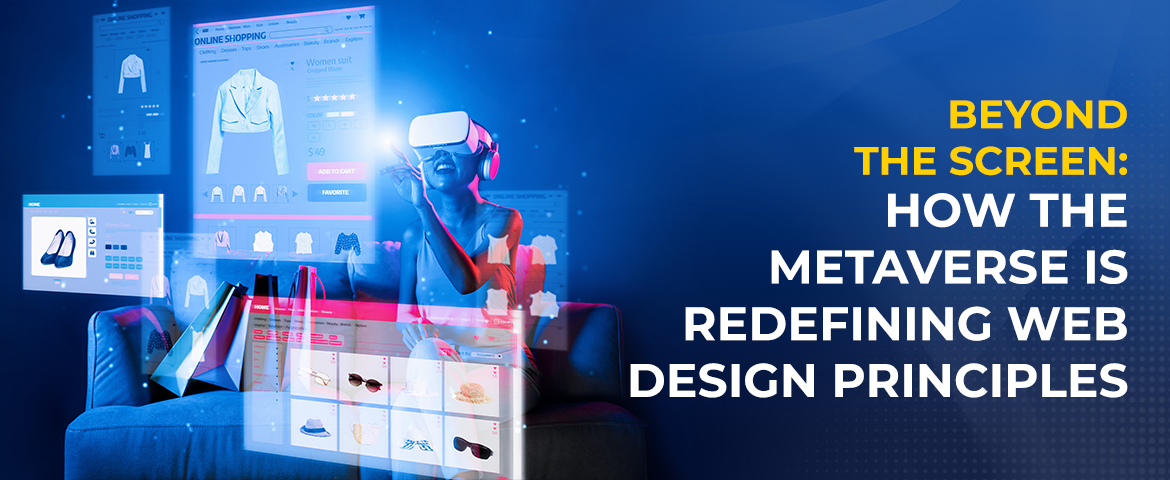
The Metaverse in Relevance to Web Design and Its Influence
In recent years, the phrase ‘metaverse’ is often thrown around by techies, designers, and users alike. There is a great promise with incorporating the metaverse, as it opens new possibilities to interact in a digital environment. Whenever different realms merge together such as physical and virtual spaces, the principles of web design vigorously evolve with this progression. This blog by the best web design company in UAE will focus first on the major transformations of the web design, which occur under the influence of the metaverse, improving user-involvement and enhancing virtual and augmented reality use in web applications.
Grasping the Metaverse
The metaverse is defined as a combination of digital space composed of augmented reality, virtual reality, and the internet. It allows people to engage with a computer-generated environment as well as other users within such environments. It is a concept which is pursued by many technological companies as it is perceived that the metaverse is an era where social, commercial, and fun activities happen in the only place: in cyberspace.
Rethinking Design Principles
- Shift from 2D to 3D design principles for the metaverse: With respect to the design of the traditional web these interactions are two-dimensional in nature, but as can be seen in the metaverse there is a lot more to grab than 3D principles. Creators will build zones that are not passive and will subject users to change in motion, space, and activity levels.
- Real User Experience: In the case of metaverse user experience, it mostly focuses on live interactions with users and their presence in the virtual world. It is therefore crucial for design and development teams to apply user-focused design principles by looking at how the user will inhabit and operate in the created environments and how the interface will look like with the aim of enabling engagement.
- The principles of 3D web design: It is apparent that after web designing goes into a 3D extension, such principles cannot be overshadowed as they form a basis of the principle with respect to 2D extensions. Virtual worlds though require special conditions especially for the people suffering from disabilities, such as voice control, and haptic interface interaction and allow other navigational control techniques.
- Spatial Design: In contrast to the common web design approach, which utilizes a flat and two-dimensional canvas, designers in the metaverse have to evolve their understanding of the emphasis on spatial design. This entails how elements are layered in a three-dimensional aspect, how the elements are said to be arranged to create a natural flow of action and how users are able to engage with the objects in a particular scene more naturally.
- Emotional Engagement: The great aspect of the metaverse is its ability to aid in the emotional storytelling experience. Designers should, therefore, take the opportunity to develop emotional experiences through the effective use of narrative as a tool to enhance users’ interaction with the content and ensure the users develop a deeper bond with the content.
- Dynamic Environments: The metaverse enables web applications to take advantage of different environments which can be developed in accordance to the users performing different actions. Designers can design games in which the environment may change with the user, creating a sense of control and involvement.
Enhancing User Experience
- Social Interactions: The metaverse connects people together, allowing the users to meet other people virtually in a shared space. These social interactions have to be considered in the process of web design, and social features must be included such as avatars and conversations as well as means of cooperation and interaction to boost the community.
- Personalization: Users come to the metaverse expecting a customized experience based on their preferences. Data and AI can be used by designers to create relevant spaces that meet the user’s behaviors, preferences, and interests, providing users with greater satisfaction.
- Gamification: It helps build a metaverse surrounding to earn more engagement while using web applications by overlaying fun assets to them, bringing rewarding challenges and an immersive experience to users so that they compel them to explore and actively participate within their worlds.
- Multimodal Interaction: Multiple different methods may have been adopted for the user to interact with metaverse applications, including voice commands, gestures, and traditional inputs. How these interactions may be integrated into a seamless experience should be dealt with by designers.
- Feedback Delivery Systems: The user experience could be enhanced using some real-time feedback mechanisms using visual cues, sound effects, or even haptic feedback so that the user will be able to feel instant remediation after an activity, making interactions feel satisfying and intuitively designed.
- Community Building: The metaverse thrives on community interactions. Designers can design specific spaces for interaction in the community, virtual meetups, forums, collaborative work, and more to give a feeling of belonging to users.
The Synergy of Virtual and Augmented Realities
- AR and VR Interfaces: The inclusion of AR and VR in website design then presents a new dimension for web users and interaction. Developers can design web-based applications to give the user opportunities to interfere with objects augmented in the real world or to get into virtual augmented reality.
- Cross-Platform Experiences: Consequently, multi-screen interactions and blended contexts between a company’s web presence and a metaverse domain necessitate web design that can support transitions from the former to the latter. This is with respect to the responsive design principles which adapts to different monitor sizes and operation modes as well.
- Content Creation and Sharing: The metaverse encourages the ability to share experiences as users can create content themselves. Designers also must make tools and interfaces easy to use, so that users are able to help build and modify their environments.
Future Considerations
- Ethical Design: Designers must ensure that as the metaverse grows, its ethical, environmental and sociocultural policies will as well. Privacy concerns, addiction risks and security of information for designers and users add the layer of the prospective students should derive the guidelines labeled responsible usage of the metaverse.
- Sustainability: It should be borne in mind that the metaverse does not exist in a vacuum. Designers should investigate possible energy-saving measures such as lowering the energy load in the hosting of a virtual world or the design of that world.
- Education and Training: The metaverse has potential in both education and training in forming engaging and interactive experiences. Designers should be able to design educational websites that utilize the features of VR and AR to simulate actual scenarios where students can learn more efficiently.
- Cultural Sensitivity: Since the metaverse has become very accessible, it is vital that the developing countries be able to capture cultural differences, and sensitivities in order to develop appropriate content within industry standards.
Web Design Tips for the Metaverse
Web designers cannot help but adjust their tactics as the metaverse grows from just hulls of ideas to having amazing and quite remarkable features. Below are some valuable tips to avoid those mistakes and successfully develop web applications for the metaverse.
- Utilize Principles of 3D Design: Making use of 3D Design Tools will help enhance spatial environments that provide height and width. Making different elements that will be used for navigation should be part of the design so that there is a focus on enhancing interactivity.
- Apply the UX Design Perspective: Devote time to think about the user experience and more importantly, the way users will interact. Test your prototypes, make sure they are actually used rather than sitting behind an unresponsive webpage, and design virtual spaces that satisfy your audience’s needs.
- Add interaction through different modalities: Use a mix of direct manipulation and virtual corporealism and allow for several other inputs to be interfaced. Such diversity enables effective engagement with your application's content.
- Implement Changes based on immediate user interaction: Feedback is particularly useful when it’s immediate, so talking about adding features trying to help people should not be the first course of action. Always speak about alterations to UI elements.
- Do Not Discriminate: Take into account all possible combinations of surrounding and target audience, and revamp your product designs accordingly. Include alternative text on images, incorporate a network and visual design to guide the user instead of guessing where they can go.
- Make Use Of Gamification Strategies: Invite users with rewards, contests, and level advancement features they would find intriguing. Education gets more pleasurable with gamification and so does the participation.
- Be Ready To Achieve Consistency In All Applications: Maintain a good user experience by enhancing visual components allowing interchange between standard web programs and highly powerful virtual space.
- Do Not Forget About Storytelling: Enhance the communication with users by taking them through the deserved process of storytelling. Using verbal images for anticipating touch with content is a great benefit.
- Make Sure To Always Follow The Developments: Be aware of what’s new in AR, VR, and metaverse trends. Knowing the new tools and components and design principles will aid you in providing new and viable applications.
Conclusion
Fundamentally, the metaverse is changing web design principles and user experience. As the web designers increasingly begin to adopt the immersive environment and invest in the user first approach, they will begin to engage the web to develop the interactive metaverse applications, which will resonate with the users. The issue boils down to striking a balance between innovation and accessibility: can we get these new digital spaces to be user friendly and inclusive? And as a process, we will see the metaverse changing the way we engage with digital spaces in general which is an exciting space for web designers to develop and get creative.
- Transform Your Digital Presence with HelloPixels: WE ARE the #1 Web Design Agency in UAE!
We at HelloPixels know that the future of web design is in the metaverse where immersive experiences and far reaching interaction set the stage for truly engaging users. Being the best web design firm in UAE, we commit to making use of the best technology to design beautiful and user friendly designs that wow. Based in Dubai, our team of talented designers and developers can guide you to these new digital zones while your brand shines and gets your listeners to feel engaged with your offerings.

Choosing between SAP Business One and SAP Business By Design
Technology is constantly evolving to introduce better and more efficient ways of doing business. Man

The Rise of UAE Online Shopping Apps: Best Platforms for Shopping
The retail scene in the United Arab Emirates has changed drastically in the last few years, thanks i
A Beginner’s Guide to Designing Accessible Websites
In this digital era, websites should be built for all users. As the #1 web design agency in the UAE,


